
Table of Contents
By Marine Larmier - Last update on
Not sure how to get your site featured in ChatGPT, Google AI Overviews, Gemini, Claude, or Perplexity? Then it’s time to learn how to optimize WordPress for AI search.
Unlike traditional search engines that rank pages, AI systems retrieve information, summarize it, and generate answers using information from multiple sources. AI visibility depends on factors such as content clarity, semantic structure, answer formatting, crawlability, authority, and technical performance.
This shift has given rise to Generative Engine Optimization (GEO): the practice of optimizing content so AI systems can retrieve, understand, and cite it. As AI search grows, WordPress websites should combine SEO and GEO to maximize visibility.
In this guide, you’ll learn the key AI search ranking factors, WordPress AI optimization best practices, and practical ways to improve visibility in ChatGPT, Google AI Overviews, and other AI search engines, supported by recent AI search research and industry studies.
| Key Takeaways TL;DR – What you’ll learn ✅ AI systems often retrieve specific content sections, so clear structure, answer formatting, and content chunking can improve citation potential. ✅ Topical authority, internal linking, schema markup, and entity relationships help AI systems better understand and connect your content. ✅ Real-world experience, expertise, testing, and original insights make your content more trustworthy and increase the chance to be cited by AIs. ✅ Fast-loading websites support better crawlability, accessibility, user experience, and content retrieval. ✅ WP Rocket improves page speed and Core Web Vitals automatically, making your WordPress content easier to access, load, and retrieve. |
10 Ways to Optimize WordPress for AI Search Visibility
- Improve Core Web Vitals and Loading Time
- Structure Content for AI Retrieval
- Optimize for AI Crawlers
- Build Topic Authority Instead of Keyword Density
- Optimize Internal Linking for Context
- Add Schema Markup
- Improve Mobile Performance
- Optimize Images and Media
- Publish Experience-Driven Content
- Monitor AI Visibility and Performance
To appear in ChatGPT, Gemini, Claude, Perplexity, or Google AI Overviews, your WordPress content must be easy to discover, easy to understand, and trustworthy enough to cite.
Most AI search optimization factors are already aligned with SEO best practices. By improving your website’s performance, content structure, topical authority, crawlability, and trust signals, you can increase your chances of being retrieved and cited in AI-generated answers.
Here are 10 actionable ways to optimize WordPress for AI search visibility:
1. Improve Core Web Vitals and Loading Time
Website speed has always been a ranking factor for SEO, but it’s also becoming increasingly important for AI search visibility.
Before an AI system can retrieve and cite your content, it needs to access, process, and understand it. Slow-loading websites consume more resources, take longer to render, and reduce crawl efficiency. Faster websites make it easier for search engines and AI systems to discover, process, and retrieve your content.
To prevent performance issues, start by monitoring your Core Web Vitals and performance thresholds:
- Largest Contentful Paint (LCP) measures loading performance. Aim for less than 2.5 seconds.
- Cumulative Layout Shift (CLS) measures visual stability. Aim for less than 0.1.
- Interaction to Next Paint (INP) measures responsiveness. Aim for less than 200 milliseconds.
- Time to First Byte (TTFB): Measures server response time. Aim for less than 200 milliseconds whenever possible.
TTFB is particularly important because it measures how quickly your server starts delivering content. When a server takes 1.5 seconds or more to generate HTML, search engines and AI systems must wait longer before they can access the page content, reducing crawl efficiency and slowing content discovery.
Better performance means more content can be crawled, indexed, and potentially retrieved by AI systems.
| ⚠️ Important: While speed alone won’t determine AI citations, it supports crawl efficiency, content accessibility, user experience, authority and Core Web Vitals, all factors that can contribute to AI search visibility. |
🛠️ Best Tools to Improve Core Web Vitals for AI Search Visibility
WP Rocket is the easiest WordPress performance plugin to improve Core Web Vitals for AI search visibility in tools like ChatGPT, Gemini, Claude, Perplexity, and Google AI Overviews. Upon activation, WP Rocket automatically enables caching, GZIP compression, lazy rendering, critical image optimization and Google font optimization. Additional performance features can be enabled in a few clicks, including Remove Unused CSS, Delay JavaScript Execution and Lazy loading.
WP Rocket optimizations can help improve key metrics such as LCP, INP, CLS, and TTFB, resulting in faster-loading pages and a more efficient crawling experience.
| 💡 Hint: Website speed isn’t the only factor behind AI citations, but it supports crawl efficiency and content accessibility. Check your Core Web Vitals performance with Gtmetrix . You can also use Rocket Insights to measure key metrics like your overall performance score, LCP, CLS, TBT, and TTFB and know exactly which WP Rocket feature to enable next, with no more guesswork. |
2. Structure Content for AI Retrieval
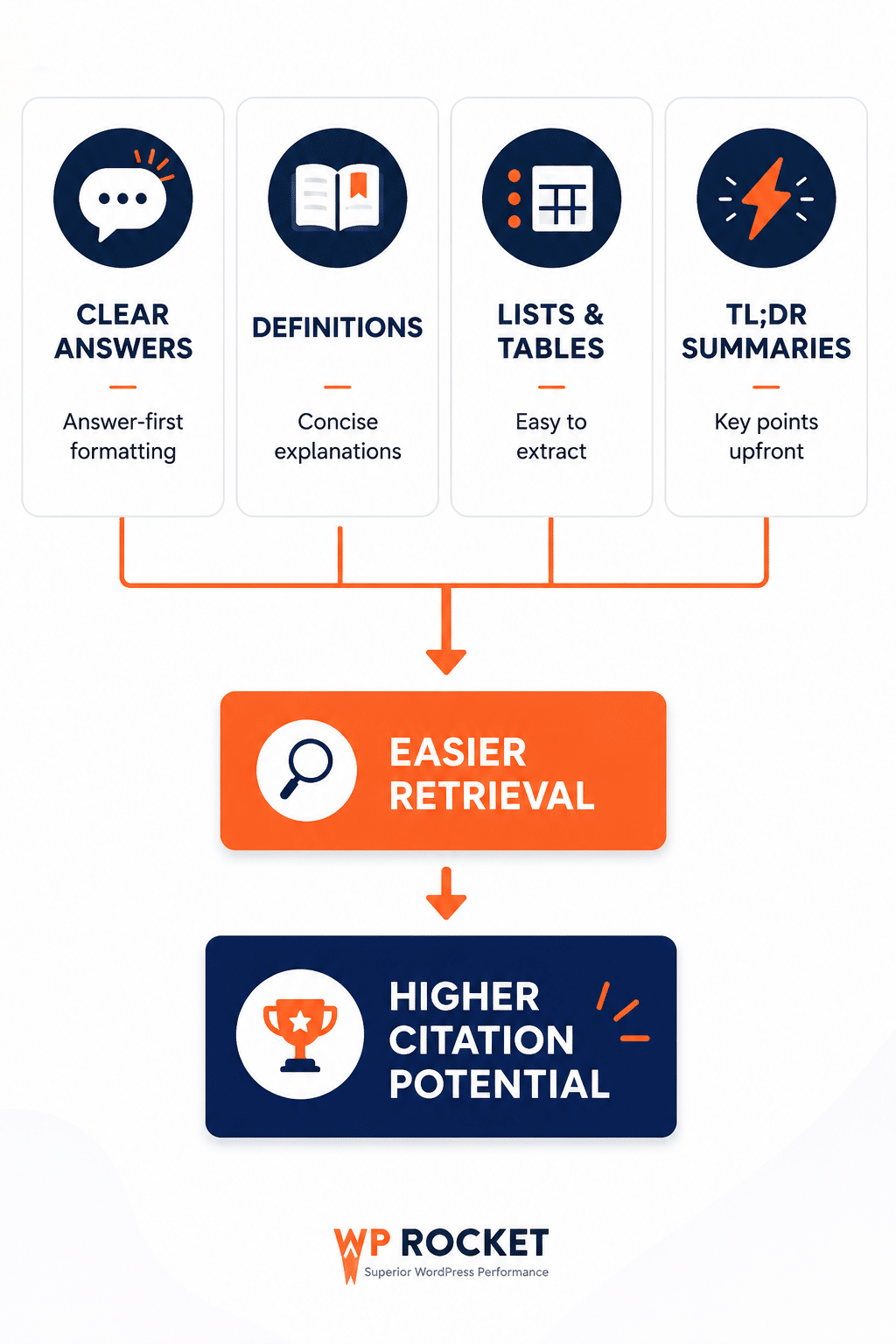
One of the biggest drivers of AI citations is content structure. Unlike traditional search engines, AI systems often retrieve and cite specific sections of content rather than entire pages. AI engines like ChatGPT, Gemini, Claude, and Perplexity tend to favor content that clearly answers questions, and is easy to retrieve and understand.
Follow the formatting techniques, along with practical examples, that you can copy, adapt, and apply to your own content to help AI systems cite it more effectively.
- Use answer-first formatting
Don’t write three endless paragraphs of context before answering a simple H2.
🔍 Example:
H2 – What Are Core Web Vitals?
Core Web Vitals are Google’s metrics for measuring loading speed, responsiveness, and visual stability.
- Add clear definitions
AI systems prefer concise definitions because they’re easy to quote.
🔍 Example:
What is LCP?
Largest Contentful Paint (LCP) measures how long it takes the largest visible element on a page to load.
- Include TL;DR summaries
Place a short summary before a long explanation or a long blog post.
🔍 Example:
TL;DR: To improve AI search visibility, focus on content quality, topical authority, Core Web Vitals, and answer-friendly formatting.
- Use Bullet lists
Lists help AI systems quickly identify key points.
🔍 Example:
The three pillars of AI search optimization are:
- Content quality
- Technical performance
- Topical authority
- Add comparison tables
Tables are one of the easiest formats for AI systems to retrieve and cite. For example, you can create this type of easy-scanning content:
| SEO | AI Search |
| Ranks pages | Generates answers |
| Displays links | Retrieves sources |
| Focuses on rankings and backlinks | Focuses on citations and authority |
| 💡 AI Search Insight: If a section of content can easily become a featured snippet, there’s a good chance it can also be retrieved and cited by AI search engines. |
If you are more of a visual learner, here’s a short recap about content structure in AI search:
3. Optimize for AI Crawlers
AI crawler optimization is closely linked to technical SEO and performance. The goal is simple: make your WordPress site easy for AI systems to access, crawl, render, and understand.
AI crawlers and retrieval systems need to reach your content before they can process or cite it. If your site blocks important bots, loads too slowly, depends too heavily on JavaScript, or serves messy HTML, AI systems may have a harder time retrieving your content.
Here are the key technical areas to check for your site:
Check your robots.txt file
Your robots.txt file tells crawlers which parts of your site they can or cannot access. If your robots.txt file blocks AI-related crawlers or important content folders, your pages may not be discovered or retrieved properly.
🔍 Example:
User-agent: *
Disallow: /wp-admin/
Allow: /wp-admin/admin-ajax.php
Sitemap: https://example.com/sitemap_index.xml
This setup is useful to block sensitive WordPress admin areas while still allowing crawlers to access your public content and sitemap.
Improve crawl accessibility
Crawl accessibility means making sure crawlers can actually reach your important pages. Even if your content is excellent, AI systems may struggle to retrieve it if it is buried too deeply, missing from your sitemap, hidden behind forms, or only accessible after a login.
Why it matters: crawlers need clear paths to your content. Internal links, XML sitemaps, category pages, and clean navigation help both search engines and AI systems discover your pages faster.
For WordPress, this means:
- Keep your XML sitemap updated.
- Add internal links between related articles.
- Avoid orphan pages with no internal links.
- Make important content publicly accessible.
- Use clear categories and navigation menus.
🔍 Example:
If you publish an article about Core Web Vitals, link it to related content about caching, image optimization, CDN, and WordPress speed. This helps crawlers understand your topic cluster and topical authority.
Improve server response times
Server response time measures how quickly your server starts sending content to the browser or crawler. One key metric to measure this is Time to First Byte (TTFB). If your server is slow, crawlers and AI systems must wait longer before they can access your page content. This reduces crawl efficiency and can slow down content discovery.
Common causes of slow server response times include:
- Cheap or overloaded hosting.
- Heavy plugins.
- Inefficient database queries.
- No page caching.
- Too many uncached dynamic requests.
🚀 WP Rocket is the most powerful WordPress performance plugin that can help improving server response times by enabling caching, GZIP compression, CSS/JS optimization and optimize your database, which reduce the work your server needs to do and help pages load faster.
Fix JavaScript rendering issues
JavaScript rendering means the crawler may need to execute JavaScript before it can see the final page content. If your key content only appears after JavaScript loads, some crawlers may not see it immediately or may process it less efficiently. This can be a problem for AI search visibility because your important content should be available in the initial HTML whenever possible.
🔍 Example:
For WordPress users, this often happens with heavy page builders, sliders, product grids, or FAQ accordions. If important content only appears after JavaScript runs, crawlers may need extra processing before they can understand the page.
Keep key content available in the HTML whenever possible. Use JavaScript to enhance the experience, not to hide essential information.
🚀 GTmetrix can help identify render-blocking JavaScript, while WP Rocket can optimize its delivery with features like ”‘Delay JavaScript Execution” and “Load JavaScript Deferred”.
Use clean HTML on your site
Clean HTML means your page code is well-structured, easy to parse, and not overloaded with unnecessary elements. Clear HTML helps crawlers identify headings, paragraphs, lists, tables, links, images, and schema markup.
🔍 Example:
A clear H2 like “How to Improve Core Web Vitals on WordPress” is easier for AI systems to understand than a heading like “Making Performance Stuff Going Better.”
4. Build Topic Authority Instead of Keyword Density
Traditional SEO often focuses on “repeating” keywords throughout a page. Modern AI systems work differently because they evaluate how comprehensively you cover a topic and how well your content connects related concepts together.
Instead of publishing a long article targeting one keyword, focus on building topical authority through semantic SEO, topic clusters, and entity relationships. Clearly define your brand, products, authors, services, and key concepts, then consistently connect them to the topics you want to be known for.
📊 AI Search Stats: Longer content does not automatically increase AI visibility. Across 174,000 pages cited in AI Overviews, Ahrefs found a near-zero correlation between word count and citations. More than half (53.4%) of cited pages contained fewer than 1,000 words. (Source: Ahrefs AI Search Benchmark Report (Q4 2025 / Q1 2026)
5. Optimize Internal Linking for Context
This strategy is closely related to topic clusters and topical authority we just mentioned. Internal links provide context and they really help AI systems understand how different pieces of content connect together. They show search engines and AI systems which pages are related, which topics belong together, and which content is most important on your website.
🔍 Example: Imagine you publish an article about Core Web Vitals. Within that article, you link to related guides about caching, image optimization, CDN configuration, and GTmetrix audits. Those links help AI systems understand that all these topics belong to the larger subject of WordPress performance.
Internal links also improve crawlability by helping crawlers discover additional pages more easily. Instead of treating each article as an isolated piece of content, AI systems can follow links to understand the bigger picture and build stronger entity relationships between concepts.
For best results:
- Link related articles together naturally.
- Use descriptive anchor text instead of generic terms like “click here.”
- Connect supporting content to cornerstone or pillar pages.
- Regularly update older articles with links to newer content.
🔍 Example: Instead of writing:
“Learn more by clicking here.”
Write instead:
“Learn how to improve Core Web Vitals with page caching and image optimization.”
The second version gives both users and AI systems much more context about the destination page (which is very similar to SEO internal linking techniques in a way).
| 💡 AI Search Insight: Internal links don’t just help crawlers discover pages. They help AI systems understand relationships between topics, strengthen topical authority, and build a clearer picture of your expertise. |
6. Add Schema Markup
In technical SEO, schema markup can improve how your content appears in search results. Here’s an example of schema markup for a chocolate chip cookie recipe., you can see one appealing photo, ratings and recipe duration in a visual manner, not a regular blue link from Google.
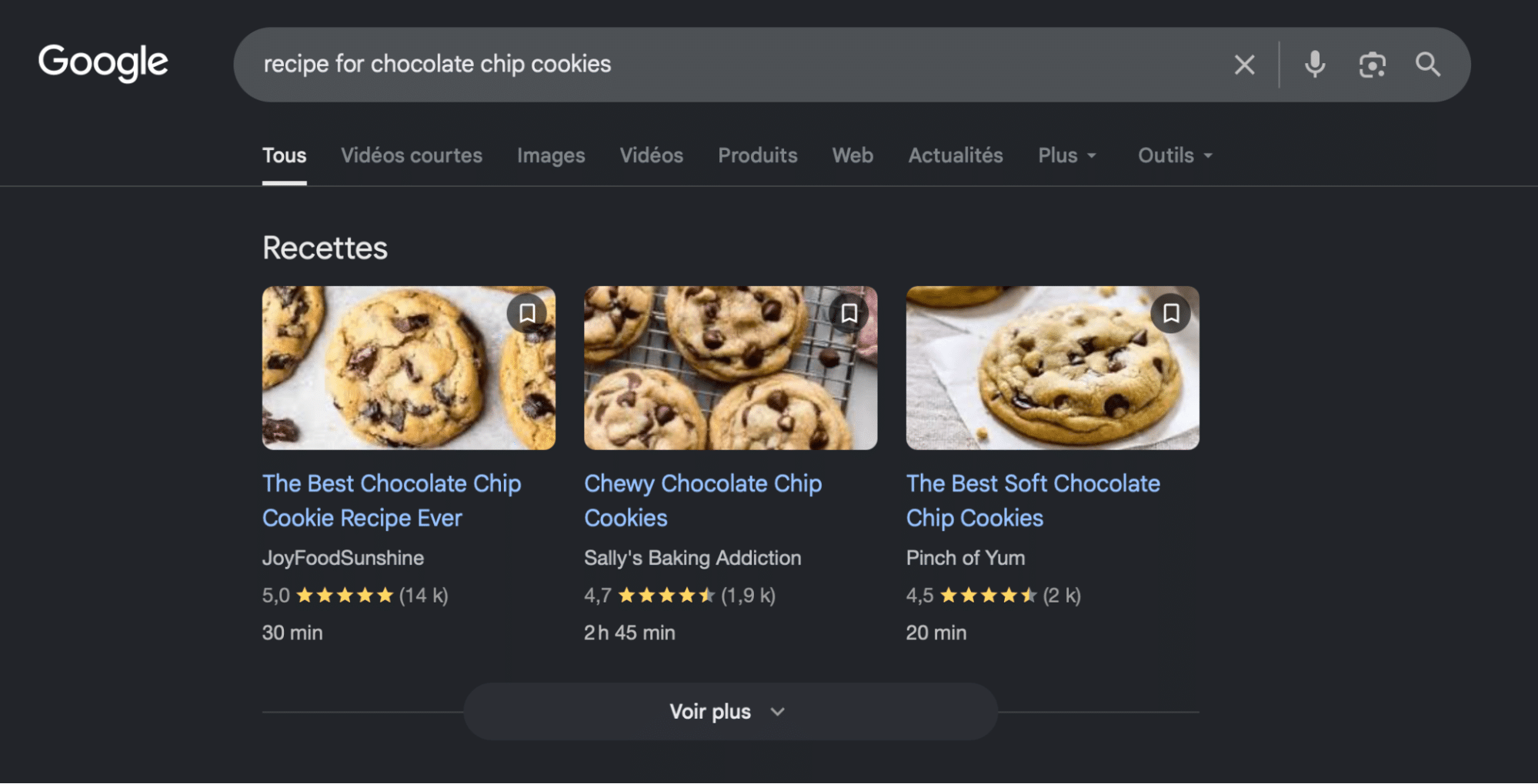
For AI search, it adds context and makes entities, topics, authors, products, FAQs, and organizations easier to identify and interpret.
🔍 Example: An FAQ schema clearly tells AI systems which text is a question and which text is the answer, making that information easier to retrieve and potentially cite.
Common schema types for WordPress include article, FAQ, How-To, WooCommerce product, organization and author.
| 💡 AI Search Insight: Schema markup won’t guarantee AI citations, but it helps AI systems understand your content more accurately and efficiently. |
7. Improve Mobile Performance
Mobile performance has been a ranking factor for years, and it remains important for AI search visibility. While AI systems don’t cite content simply because it’s mobile-friendly, fast and accessible mobile pages contribute to better Core Web Vitals, user experience, and crawl efficiency.
🔍 Example: A page that loads quickly and remains stable on mobile devices is easier for both users and crawlers to access than a slow page filled with render-blocking resources.
| 💡 AI Search Insight: Mobile performance alone won’t determine AI citations, but it supports many of the technical factors that contribute to AI search visibility. |
8. Optimize Images and Media
AI search is multimodal, meaning AI systems can understand and retrieve information from multiple content formats, including text, images, videos, audio, and documents.
AI visibility is not built on your website alone. Brand mentions on YouTube, podcasts, reviews, industry publications, and other trusted sources help reinforce brand authority across AI ecosystems.
So, if you optimize your media, you will also help AI systems better understand your content and the context surrounding it.
🔍 Example: An image with a descriptive filename, alt text, caption, and surrounding content provides much more context than an image named “IMAGE-123.webp” with no description.
For WordPress websites, make sure to:
- Use descriptive image file names.
- Add meaningful alt text.
- Optimize image size and performance.
- Include captions when relevant.
- Embed videos with supporting text.
📊 AI Search Stats: Ahrefs found that YouTube mentions had the strongest correlation with AI visibility (0.74) among all factors analyzed, suggesting that video content and brand mentions play an increasingly important role in AI search ecosystems. (Source: Ahrefs AI Search Benchmark Report (Q4 2025 / Q1 2026)
9. Publish Experience-Driven Content
AI systems increasingly favor content that demonstrates real-world experience, testing, and expertise rather than generic information that anyone could rewrite. Instead of simply describing your products, show that you have actually used, tested, compared, or worked with them.
🔍 Example: Imagine you sell sofas online. A generic article might say:
“This beige sofa is comfortable, stylish, and suitable for modern homes.”
An experience-driven article with fresh content could say:
“After testing this sofa for three months in a family living room, we found that the fabric resisted stains surprisingly well, and the seat cushions softened slightly after the first few weeks of use.”
Other examples for your WordPress site can include:
- Original product reviews.
- Before-and-after results.
- Customer case studies.
- Product comparisons.
- Test results and benchmarks.
- Photos and videos of products in real-world use.
Support this with detailed author pages, company pages, real bios, credentials, and publication information.
📊 AI Search Stats: Content freshness may also play a role in AI visibility. In an Ahrefs study of ChatGPT’s 1,000 most-cited pages, 89.7% had been updated in 2025. (Source: Ahrefs AI Search Benchmark Report (Q4 2025 / Q1 2026)
| 💡 AI Search Insight: Content freshness, first-hand experience, testing, and original insights are much harder to replicate, making them valuable signals of expertise and authority. |
10. Monitor AI Visibility and Performance
Regularly check whether your brand and content appear in ChatGPT, Gemini, Claude, Perplexity, and Google AI Overviews for your target topics. You should also monitor performance regressions, drops in Core Web Vitals, crawlability issues, or technical SEO problems that can affect how easily AI systems can retrieve and understand your content.
🔍 Example: If your site was previously cited for a topic but disappears after a redesign, review your content structure, internal linking, and website performance to understand what’s wrong.
📊 AI Search Stats: Ahrefs found that Google AI Overviews changed cited sources 70% of the time, with 45.5% of citations being completely new. The answer itself usually stayed the same, but the sources changed frequently. (Source: Ahrefs AI Search Benchmark Report (Q4 2025 / Q1 2026)
🛠️ Best Tools to Monitor AI Search Visibility and Performance
- Otterly AI: It tracks your visibility and citations across AI search engines such as ChatGPT, Gemini, and Perplexity.
- Profound: One of the leading AI visibility platforms for tracking brand mentions, citations, and presence across ChatGPT, Gemini, Claude, Perplexity, and other AI search engines.
- Writesonic: It helps track your brand and how often you’re mentioned and cited by AI search engines, identifies which sources influence AI-generated answers, and highlights opportunities to improve your AI presence.
Does Website Performance Affect AI Search Visibility?
Faster websites are generally easier for search engines and AI systems to crawl, render, and retrieve, improving crawl efficiency and content accessibility. Good Core Web Vitals also contribute to a better user experience, which can lead to stronger engagement signals over time.
While performance alone is not going to determine whether a page gets cited by AI tools, it helps create the technical foundation that makes content easier to discover, process, understand, and potentially retrieve.
How Performance Indirectly Supports AI Citations
Think of the process like this:
Performance → Better Crawlability → Better User Experience → Higher Engagement → Stronger Authority → Greater AI Citation Potential.
If you’re a visual learner, here’s a list of techniques you can follow (including performance) to be cited in AI results:
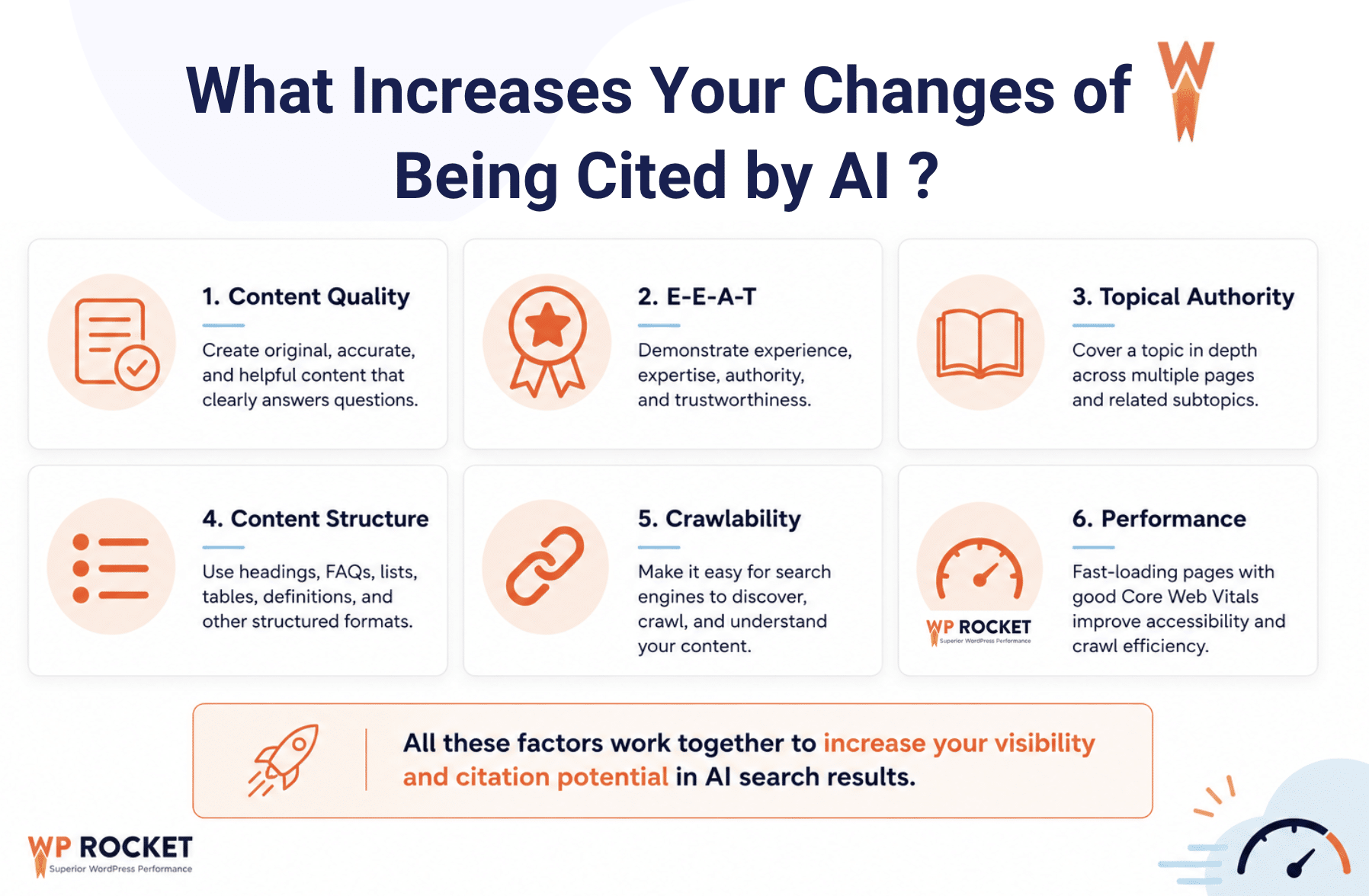
Now that we’ve covered the main ways to optimize WordPress for AI search visibility, let’s go one step further.
For the techies, here’s a quick look behind the scenes at how GEO and AI retrieval actually work, with the key terms you need to know.
How AI Search Engines Work
Unlike traditional search engines that return a list of links, AI search engines understand questions, retrieve information from multiple sources, and generate direct answers for users. Let’s explore the mechanisms behind AI search.
AI Crawlers vs Traditional Search Crawlers
While search engines like Google primarily rank web pages, AI systems such as ChatGPT, Gemini, Claude, and Perplexity retrieve information from multiple sources, synthesize it, and generate answers for users. Traditional search engines help users discover pages, while AI systems help users discover answers. That’s why content must be optimized not only for rankings, but also for retrieval, understanding, and citation.
📊 AI Search Stats: Traditional rankings still matter, but they are no longer the only path to AI visibility. Only 37.9% of pages cited in Google AI Overviews rank in the top 10 search results. Meanwhile, 31.2% rank between positions 11–100, and 31.0% do not rank in Google’s top 100 at all. (Source: Ahrefs AI Search Benchmark Report (Q4 2025 / Q1 2026)
SEO helps your pages rank in search results, while GEO (Generative Engine Optimization) helps your content get retrieved, understood, and cited by AI systems. Here’s why you need both:
| Traditional Search Crawlers | AI Crawlers & Retrieval Bots |
| ✓ Optimization approach: SEO (Search Engine Optimization) | ✓ Optimization approach: GEO (Generative Engine Optimization) |
| ✓ Objective: Improve rankings and organic traffic. | ✓ Objective: Improve retrieval, citations, and visibility in AI-generated answers. |
| ✓ Crawl and index web pages. | ✓ Retrieve content to train models or generate answers. |
| ✓ Focus on ranking pages in search results. | ✓ Focus on finding information to answer questions. |
| ✓ Usually return a list of links. | ✓ Usually generate a direct answer. |
| ✓ Evaluate signals such as relevance, authority, and user experience. | ✓ Evaluate content quality, authority, structure, and retrievability. |
| ✓ Examples: Googlebot, Bingbot, YandexBot. | ✓ Examples: GPTBot, OAI-SearchBot, PerplexityBot, ClaudeBot, Claude-SearchBot. |
You can save the table below as a quick cheat sheet to understand the differences between traditional SEO and AI search optimization (GEO).
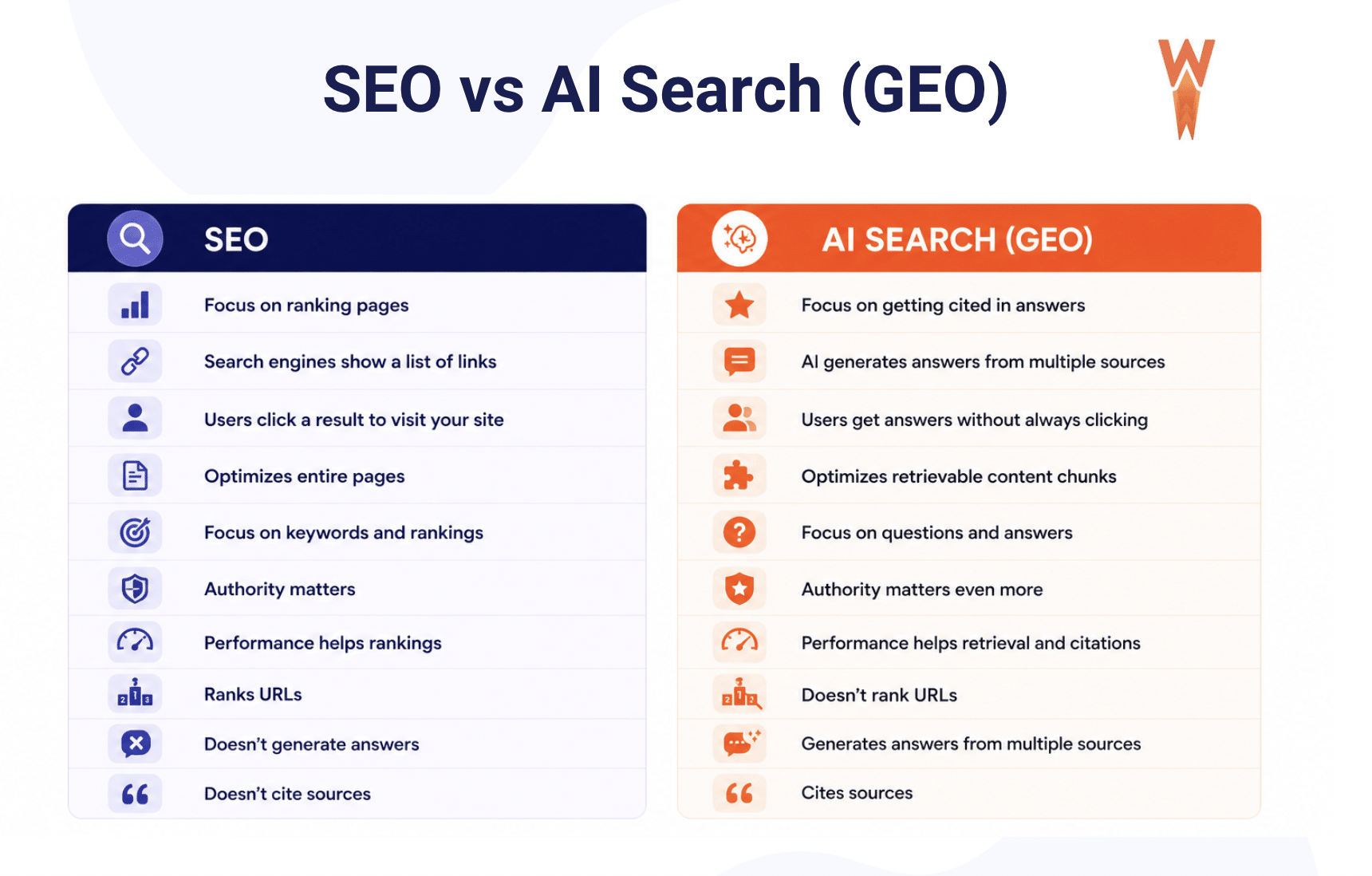
💡 Important: AI search engines do not really publish official “citation ranking factors”. The focus areas above summarize commonly observed retrieval, content quality, and authority signals that appear to help AI systems discover, understand, and cite content.
How AI Systems Retrieve Content
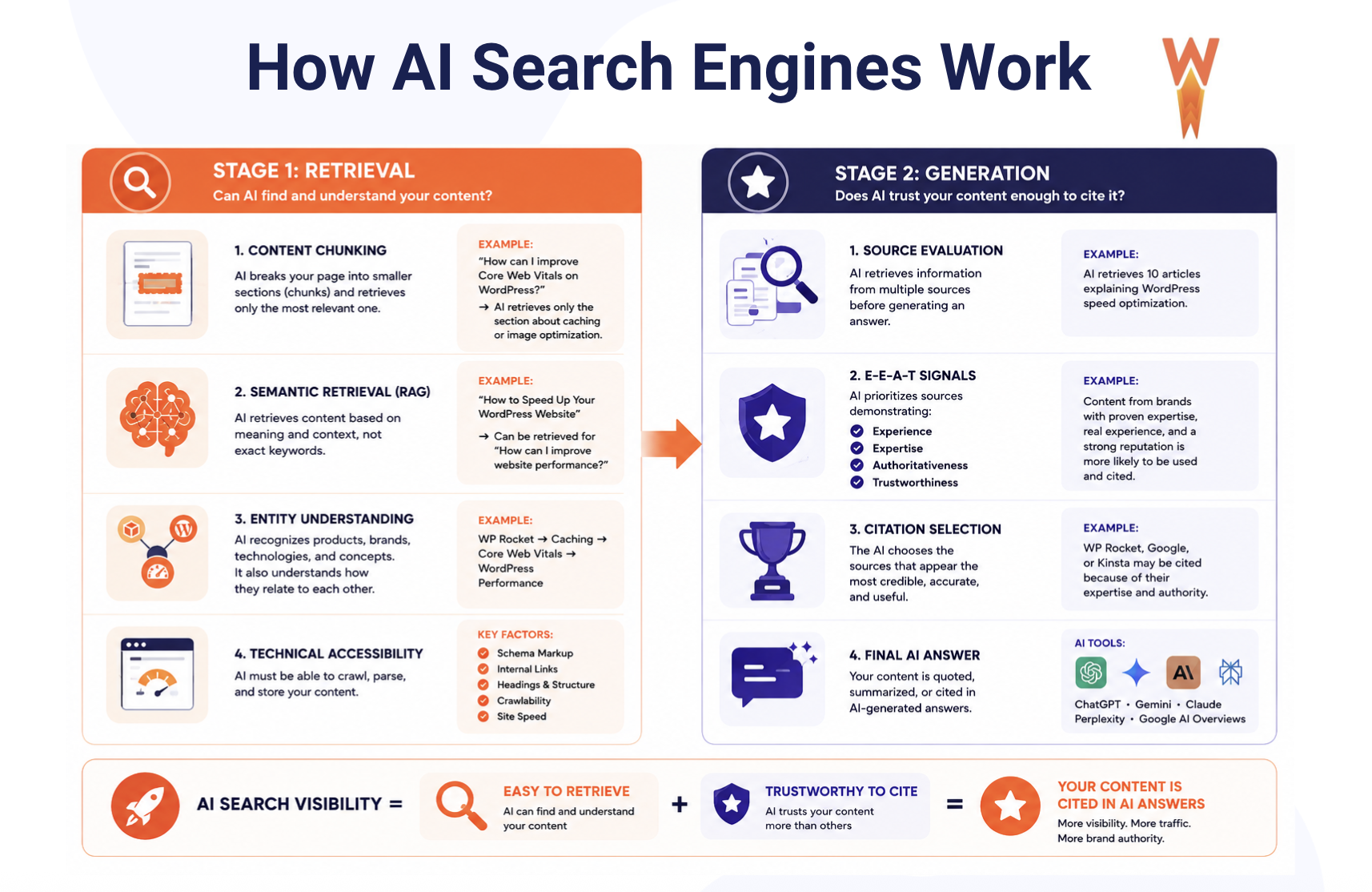
AI tools such as ChatGPT, Gemini, Claude, and Perplexity retrieve information from multiple sources and generate answers. To get cited, there are two essential stages: retrieval and generation.
Stage 1: Retrieval
Before an AI tool can cite your content, it must be able to find, understand, and retrieve it.
Content Chunking
AI search engines don’t process an entire page as a single document. Instead, they break content into smaller sections called “chunks”.
🔍 Example: If someone asks ChatGPT, “How can I improve Core Web Vitals on WordPress?”, the AI may retrieve only the section of your article about caching or image optimization rather than the full page.
Semantic Retrieval and Retrieval-Augmented Generation (RAG)
Traditional search engines often rely on keywords but AI systems go further by using semantic retrieval, which focuses on meaning and context. AI tools also use Retrieval-Augmented Generation (RAG), meaning that before generating an answer, they retrieve relevant information from external sources and use it to build their response.
When someone asks:
“How do I improve Core Web Vitals on WordPress?”
For AI systems with web access, a typical RAG process looks like this:
- Search the web.
- Retrieve relevant pages.
- Read specific sections.
- Generate an answer.
- Sometimes cite sources.
A page titled “How to Speed Up Your WordPress Website” may still be retrieved for the query “How can I improve website performance?” even if the exact keywords don’t match.
💡Hint: To improve AI search optimization, focus on answering topics comprehensively and providing context rather than targeting keywords alone.
Entity Understanding
AI systems can identify entities such as brands, products, people, technologies, and concepts, and use contextual signals to understand how they relate to each other.
🔍 Example:
AI systems may associate WP Rocket with caching, Core Web Vitals, WordPress performance and page speed optimization because these topics frequently appear together across websites, documentation, reviews, and user discussions.
💡 Hint: Retrieval depends heavily on technical accessibility. Well-structured content, schema markup, internal linking, crawlability, and fast-loading pages make it easier for AI systems to understand and store your content.
Stage 2: Generation
Once AI tools have gathered information from multiple sources, they must decide which content deserves to appear in the final answer.
Citation Selection and E-E-A-T
AI systems often retrieve several pages before generating a response. They then select and synthesize information from sources that appear relevant, trustworthy, and authoritative.
🔍 Example:
If multiple websites explain how to improve WordPress speed, AI systems are more likely to prioritize sources that demonstrate strong expertise, experience, authority, and trustworthiness rather than a latest blog with zero visits, spelling mistakes and wrong information.
This is where Google’s E-E-A-T principles become essential:
- Experience
- Expertise
- Authoritativeness
- Trustworthiness
The stronger your E-E-A-T signals, the more likely AI systems are to use and cite your content.
💡Hint: AI search visibility depends on two things: making your content easy to retrieve and trustworthy enough to cite.
If you are more a visual learner, you can save the figure below that helps to understand exactly how AI search engines work:
9 Common Mistakes That Prevent AI Citations
Not seeing your brand mentioned in ChatGPT, Gemini, Claude, Perplexity, or Google AI Overviews? Before publishing more content, check whether you’re making one of these common mistakes.
❌ Writing long introductions before answering the question
Many business websites spend three paragraphs talking about themselves before addressing the user’s problem. AI systems prefer pages that provide a direct answer first.
❌ Treating AI content like a volume game
Publishing dozens of generic AI-generated articles without expertise, testing, customer stories, or original insights rarely builds authority. AI systems can find generic information everywhere.
❌ Targeting keywords instead of building topic authority
Many WordPress site owners publish one article per keyword. AI systems look for broader expertise. A complete content cluster around WordPress security or WooCommerce performance is often more valuable than a single optimized page.
❌ Weak internal linking between related content
If your articles about caching, Core Web Vitals, image optimization, and CDN never link to each other, AI systems have a harder time understanding your expertise and topical authority.
❌ Using page builders that hide important content behind JavaScript
Heavy sliders, tabs, accordions, and dynamic content can make information harder to process. Keep key content visible and accessible in the HTML whenever possible.
❌ Failing to define entities and context
AI systems need to understand who you are. Clearly explain your products, services, authors, expertise, and industry relationships throughout your website.
❌ Ignoring schema markup
Without structured data, AI systems have fewer signals to understand your content, authors, FAQs, products, and organization.
❌ Neglecting mobile performance and user experience
A slow mobile experience won’t automatically prevent citations, but it can reduce accessibility, engagement, and the overall quality signals surrounding your content.
❌ Publishing content without proof or experience
If you’re a hosting company, show real uptime data. If you’re a WordPress agency, share client results. If you sell sofas, include customer photos, tests, and comparisons. Original experience is much harder for AI systems to ignore than generic claims.
| 💡 AI Search Insight: Many websites focus on producing more content when the real problem is a lack of expertise, structure, authority, and context. In AI search, being the most useful source often matters more than being the blog with the biggest amount of articles. |
WordPress AI Search Optimization Checklist
We’ve covered a lot of concepts, from AI retrieval and content chunking to topical authority and Core Web Vitals. Use the checklist below to quickly assess whether your WordPress site is optimized for AI search visibility.
| AI Search Optimization Checklist | What to Do |
| ✓ Content Structure | Use a clear H1 → H2 → H3 hierarchy and break content into short, topic-focused sections that AI systems can retrieve independently. |
| ✓ Answer Formatting | Answer key questions directly, add concise definitions, TL;DRs, bullet lists, numbered steps, and comparison tables. |
| ✓ Semantic Coverage | Cover related concepts, questions, and use cases, not only exact-match keywords, so AI systems can retrieve your content based on meaning. |
| ✓ Topic Authority | Build topic clusters and content hubs around your main subjects to strengthen your authority. |
| ✓ Entity Understanding | Clearly define your brand, products, authors, services, and key concepts, and consistently connect them to the topics you want to be known for. |
| ✓ Internal Linking & Crawlability | Link related content with descriptive anchor text, maintain an XML sitemap, avoid orphan pages, and make sure important content is accessible in robots.txt. |
| ✓ Schema Markup & Clean HTML | Use relevant Article, FAQ, Product, Author, and Organization schema, plus semantic headings, descriptive links, lists, tables, and alt text. |
| ✓ Technical Accessibility | Avoid hiding important content behind JavaScript and make sure text, images, videos, and other media are easy for crawlers and AI systems to understand. |
| ✓ Performance & Core Web Vitals | Monitor and optimize LCP, CLS, INP, and TTFB with GTmetrix. WP Rocket helps improve page speed, Core Web Vitals, mobile performance, and crawl efficiency. |
| ✓ Trust & Experience Signals | Publish original tests, case studies, benchmarks, reviews, first-hand insights, strong author profiles, and earn mentions through partnerships, podcasts, guest posts, and industry publications. |
FAQ
Does Website Speed Affect AI Search Visibility?
Yes, but indirectly. Faster websites are generally easier for AI systems to crawl, render, and retrieve. Good performance also supports crawlability, accessibility, Core Web Vitals, and user experience. While speed alone won’t guarantee AI citations, it helps create the technical foundation that supports AI search visibility.
Do Core Web Vitals Matter for AI Search Engines?
Core Web Vitals are not known AI citation factors, but they contribute to better website performance and user experience. Strong Core Web Vitals can improve crawl efficiency, accessibility, and engagement, all of which support the broader signals that AI systems may use when retrieving content.
How Do AI Search Engines Crawl WordPress Websites?
AI systems use crawlers and retrieval bots to discover and access content. They rely on factors such as internal linking, XML sitemaps, content structure, and technical accessibility. Once content is retrieved, AI systems analyze and use relevant sections to generate answers.
How Do I Optimize WordPress Content for ChatGPT Citations?
Focus on clear answers, strong content structure, topical authority, and E-E-A-T. Use headings, definitions, FAQs, tables, and internal links to make content easier to retrieve and understand. The goal is to create content that AI systems can confidently access, interpret, and cite.
Does Schema Markup Help AI Search Engines Understand Content?
Yes. Schema markup provides structured information about your content, including articles, products, FAQs, authors, and organizations. While it doesn’t guarantee AI citations, it helps AI systems better understand page context, entities, and relationships.
What Is llms.txt and Does WordPress Need It?
llms.txt is a file designed to help AI systems discover and understand website content. At the moment, adoption remains limited and most AI platforms do not rely on it. For most WordPress sites, strong content, crawlability, and technical SEO remain more important.
Can AI Search Engines Read JavaScript-Heavy WordPress Websites?
Sometimes, JavaScript can make content harder to access and process. If important information only appears after scripts load, retrieval may become less efficient. Keep key content available in the HTML whenever possible and use JavaScript to enhance the experience rather than hide essential information.
What Is the Best Way to Improve WordPress Performance for AI Search?
Start with Core Web Vitals, caching, image optimization, and code optimization. WP Rocket is the easiest WordPress performance plugin for improving page speed and Core Web Vitals, applying most of the performance best practices automatically upon activation.
Wrapping Up
The first step toward AI search optimization (or GEO) is making sure your website is accessible, easy to understand, and technically sound. Performance helps support that foundation.
Success in AI search depends on creating content that AI systems can retrieve, understand, trust, and cite. That’s why factors such as content quality, E-E-A-T, topical authority, content structure, crawlability, and semantic context remain at the core of AI search optimization.
On the performance side, WP Rocket helps improve page speed and Core Web Vitals automatically, creating a stronger technical foundation for both SEO and AI search visibility.
Ready to optimize WordPress for AI search? Try WP Rocket risk-free with a 14-day money-back guarantee and start improving website performance, Core Web Vitals, user experience, and AI search visibility today.