

Table of Contents
Last update on
This is a guest post. Opinions and recommendations are the author’s own.
GruffyGoat is a web design and development agency in Greenville, South Carolina. Over the past 14 years, we have built and now maintain hundreds of WordPress sites for small businesses, nonprofits, and agencies that hand over their development work to us. We are not a launch-and-leave shop. The relationships we care about look less like a project and more like a fractional teammate, which means the day a site goes live is the day the real work starts.
Speed is part of that work, and it does not get to be optional. WP Rocket has been on every WordPress site we build for over 5 years. A new client, a redesign, a white-label job for a partner agency, it makes no difference. WP Rocket goes on before launch, the same way you would not hand over a car without tires. Here is how it became standard equipment for us and why it has stayed that way.
Speed Stopped Being Optional
When GruffyGoat started back in 2012, site speed was something you glanced at near the end of a build and then mostly forgot. That has not been true for a long time.
Two things changed it. Google made Core Web Vitals a ranking signal, so a slow site is now a quiet tax on a client’s search visibility. And visitors stopped being patient, especially on phones, where most of our clients’ traffic now comes from. A small business owner does not read a report about Largest Contentful Paint. They feel a site that drags, and so do the people they are trying to reach.
The harder problem for an agency of our size was not any single slow site. It was consistency. Every WordPress site gains weight over time. A plugin here, a tracking pixel a client’s marketer adds there, a page builder doing more than it should. A site that scored well at launch drifts. We were not keeping one site fast. We were keeping hundreds of them fast, across different themes, builders, hosts, and client habits. Hand-tuning each one was not a plan. It was a slow leak.
What We Tried First
Before WP Rocket, we did what most agencies do. We stacked free plugins. One for caching, another for minification, a third for lazy loading, each with its own settings screen and its own opinions.
That can work. It is also fragile. A setting that helped one site would break another. A theme update would undo a week of careful tuning. Every site needed its own babysitting, and when something broke after hours, there was no one to call. Free tools are not free. They are paid for in our team’s time, and that bill came due every month.
We were not looking for magic. We were looking for something boring in the best sense of the word. Predictable. The same on every site. Something we could put on a checklist and trust without checking it twice.
Why We Bought It, and the Concern We Had First
We kept hearing the WP Rocket name. In WordPress community threads, from other developers, in the kind of recommendation that comes up when people compare notes on what actually holds up. Eventually, we stopped reading about it and tested it.
We did have one real hesitation. WP Rocket is a paid plugin, and we use it on every site, so the cost isn’t per license. It grows right alongside us. On top of that, we host most client sites on managed WordPress hosting that already runs server-level caching. Adding another caching layer sounded like a good way to start a fight between two tools.
It did not. WP Rocket sat next to the host’s caching without conflict and took care of the parts server caching does not touch, the JavaScript, the CSS, and the way images load. It was also faster to set up than the free stack we were replacing. The number one reason we bought it was not a single feature. It was that one tool did the whole job, the same way, on every site. For an agency, repeatable beats clever.
What We Actually Use
WP Rocket turns on a large share of its work the moment it is activated, which is the point. A few features do the heavy lifting on the 90-plus mobile scores and green Core Web Vitals our clients care about:
- Page caching. On by default. It is the foundation, and it is one less thing for us to think about.
- Delay JavaScript Execution. The single biggest lever we have for mobile. Most of what slows a modern WordPress site is scripts, including the third-party ones clients add without telling us. Holding them until a visitor interacts with the page is what moves a mobile score from middling to green.
- Remove Unused CSS. Page builders like Elementor and Divi ship a lot of CSS that a given page never uses. Clearing that render-blocking weight off the top of the page is often the difference in Largest Contentful Paint.
- LazyLoad. Images load as visitors scroll to them, not all at once. Simple, and it matters most on the long, image-heavy pages small businesses tend to want.
- Font preloading. Cuts the small layout shifts and delays that come from web fonts loading late.
None of this asks a developer to hand-write anything. That is what makes it usable across hundreds of sites instead of a handful.
One more piece of how we use WP Rocket sits outside the score chasing. A lot of the servers our clients run use Varnish, a server-level cache. WP Rocket’s Varnish add-on clears that server cache from inside WordPress, so we manage it there instead of the host’s own integration. When a site’s cache needs clearing, we do it in one place rather than logging into a separate hosting panel. It sounds minor. Across hundreds of sites, the minor things are what add up.
What It Looks Like in the Numbers
A page-builder site is the fair test, because that is where the weight is. The builder-heavy sites we rebuild often start in the 40s and 50s on mobile PageSpeed Insights. That is normal for a content-rich site running a visual builder and a few marketing scripts.
With WP Rocket configured, those same sites land in the 90s on mobile and go green across Core Web Vitals.
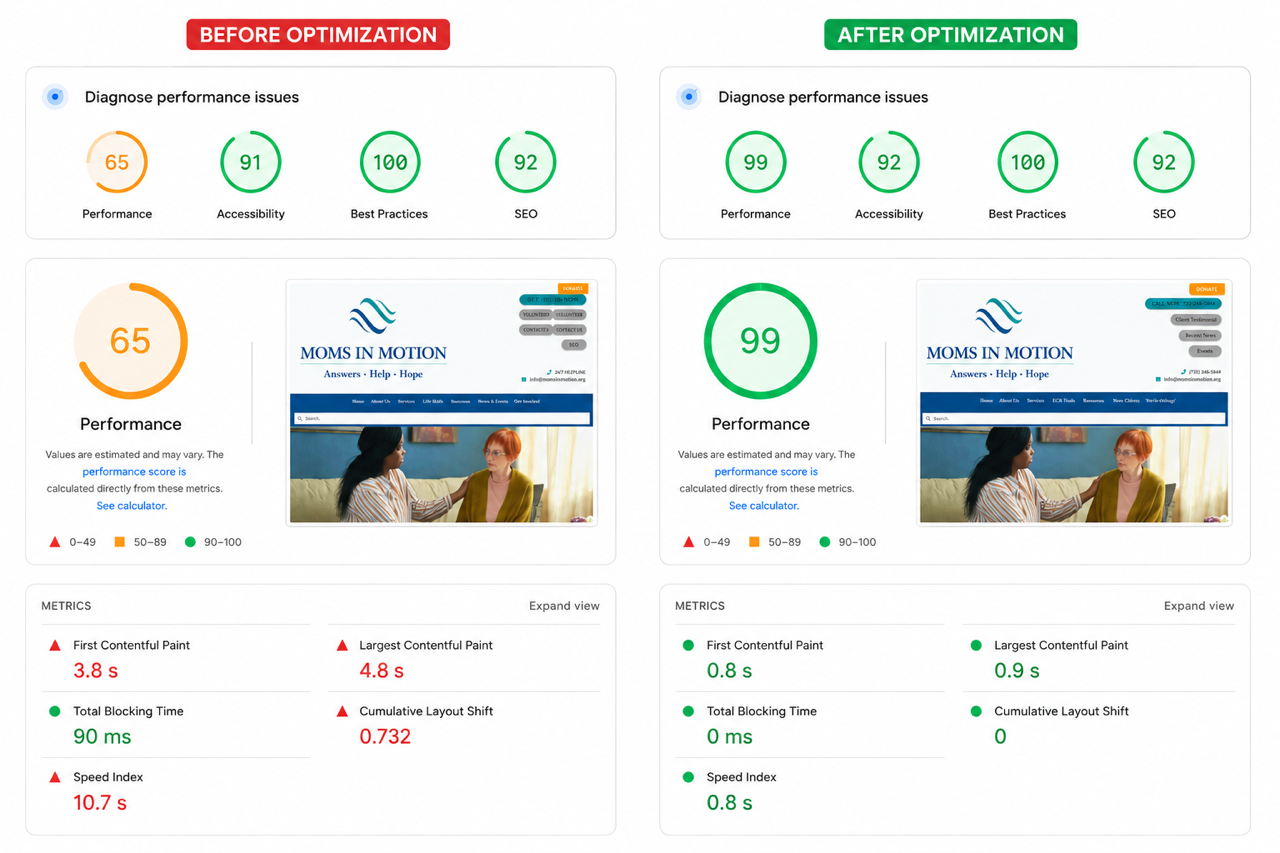
The number on the screen is the easy part to show. The result we value more is the quieter one. We get fewer speed complaints, fewer after-hours fires, and far fewer sites that slip below where they should be between visits. Our clients do not think about their site’s performance, which means we have done our job. And because Core Web Vitals feed search ranking, the same work that makes a site feel faster also protects the visibility a client is paying us to grow.
WP Rocket is the rare tool we never have to sell internally and never have to apologize for. It does what it says on every site, and then it gets out of the way.
The Hardest Thing It Has Helped With
The toughest sites are page-builder builds, the Elementor and Divi sites that give clients the layout freedom they want and hand us a pile of JavaScript and CSS in return. Add the third-party scripts that show up later, a chat widget, a booking embed, two analytics tags, and a site that launched fast can fall behind without anyone touching the design.
That is where WP Rocket earns its place. Delay JavaScript Execution and Remove Unused CSS do most of the work, and they do it without us having to rebuild the site or telling a client to give up the builder they like. We get to keep the promise we made about how the site would feel, even after the client has added things we did not plan for. For a support-first agency, that matters more than a perfect launch-day score.
What We Tell Other Agencies
A few things we would tell another agency weighing this.
- Speed is not a launch task. It is a maintenance task. A site is fastest the week it goes live, and works against you from there. If performance is not part of your ongoing hosting and maintenance work, it is not really handled.
- Make it standard, not a per-project decision. The agencies that struggle with speed are usually the ones deciding, on a site-by-site basis, whether it is worth the effort. Decide once. Put it on everything. Take it off the table.
- Test the JavaScript and CSS settings. Do not just switch them on and walk away. They are the strongest features and the ones most able to break a layout. Five minutes of checking per site is cheap insurance.
- And good hosting and WP Rocket are not an either-or. Managed hosting handles the server. WP Rocket handles the front end. They are doing different jobs, and the sites we are proudest of use both.
Why It Is Still on Every Site
If WP Rocket disappeared tomorrow, the thing we would miss is not a feature. It is not having to think about it. Going back to a stack of free plugins would mean handing our team back hours every month and handing our clients back a slower, less steady site. That is a trade we are not interested in.
It has held up better than we expected, and we did not expect little. A tool that stays this useful for this long, through every change WordPress and Google have thrown at it, is rare. It became standard equipment at GruffyGoat because it does one hard job well and asks for almost nothing in return.
If you run an agency and you are still tuning sites one at a time, that is the case for WP Rocket in a sentence. Pick the tool once, put it on everything, and get your team’s attention back for the work that actually needs a human.